jueves, 24 de octubre de 2013

  
Libros   de  textos en  ingles 
 1-topnotch  
 2- Worldlink 0

house
 Italiano            


 Otros  Idiomas

domingo, 20 de octubre de 2013

http://learningenglish.voanews.com/content/money-talks/1681384.html

October 21, 2013 06:01 UTC

Audio / Words and Their Stories

Money Talks

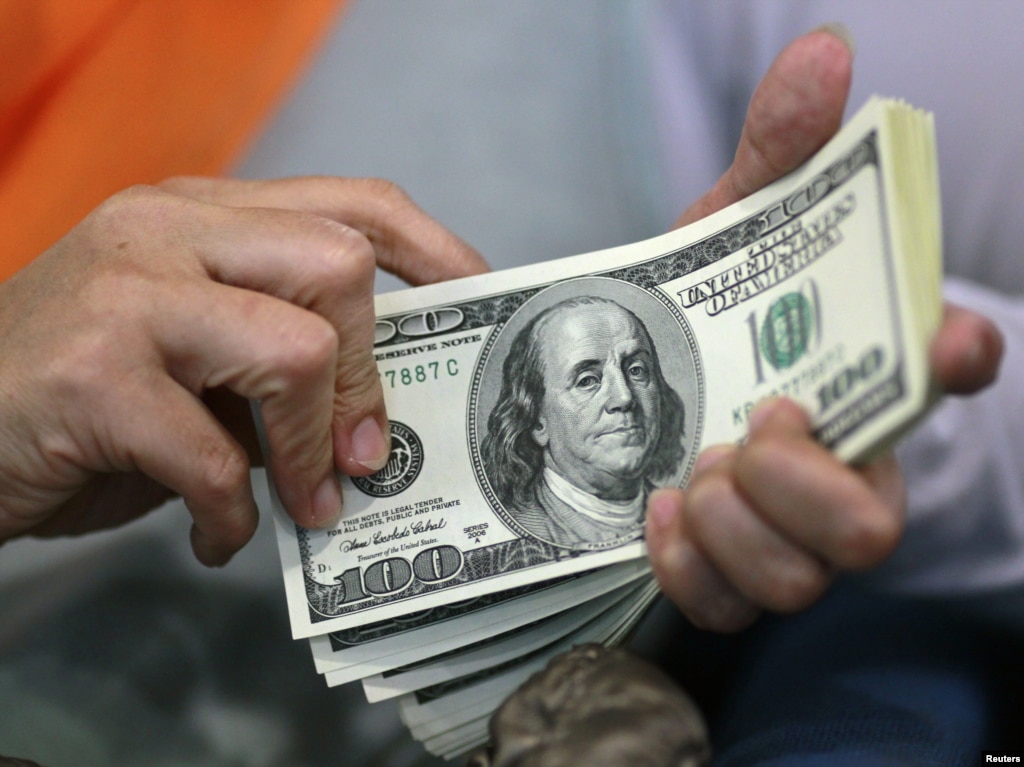
American $100 bills
American $100 bills

MULTIMEDIA

Play or download an MP3 of this story
TEXT SIZE 

I’m Susan Clark with Words and Their Stories, aprogram in Special English on the Voice of America.

People often say that money talksThey mean that aperson with a lot of money can say how he or shewants things done. But it is not easy to earn enoughmoney to gain this kind of power.

Ask anyone in a businessThey will tell you that it is ajungle out there. The expression probably beganbecause the jungle is filled with wild animals andunknown dangers that threaten peopleSometimespeople in business feel competing businesses are asdangerous as wild animals. And they feel that unknowndangers in the business world threaten the survival oftheir business.

People in business have to be careful if they are tosurvive the jungle out thereThey must not be led intomaking bogus investmentsBogus means somethingthat is not real.

Nobody is sure how the word got started. But it beganto appear in American newspapers in the eighteenhundreds. A newspaper in BostonMassachusetts saidthe word came from a criminal whose name wasBorghese. The newspaper said Borghese wrotechecks to people although he did not have enoughmoney in the bankAfter he wrote the checks, he wouldflee from townSopeople who were paid with hischecks received nothing. The newspaper saidAmericans shortened and changed the criminal's nameBorghese, to bogus.

People trying to earn money also must be aware of being ripped off. A personwho is ripped off has had something stolen, or at least has been treated veryunfairly.

writer for the magazine “American Speech” said he first saw the expressionused in 1971. It was on a sign that a student carried during a protestdemonstration at a university. The message on the sign was that the studentfelt ripped off, or cheated.

Perhaps the best way to prevent getting ripped off in business is to not try toget rich quickly. To be successful, a person in business works hard and triesto get down to brass tacks.

This expression means to get to the bottom or most important part ofsomething. For example, a salesman may talk and talk about his productwithout saying the priceYou get down to brass tacks when you say, “itsounds good, but how much does it cost?”

Word expert Charles Funk thinks the expression comes from sailors on ships.They clean the bottom of a boatWhen they have removed all the dirtthey aredown to the brass tacks, the copper pieces that hold the boat together.

Soif we get down to brass tacks, we can prevent ripoffs and bogus ways ofearning money in that jungle out there. And, some good luck will helptoo.

This Words and Their Stories was written by Jeri Watson. I’m Susan Clark.

jueves, 10 de octubre de 2013

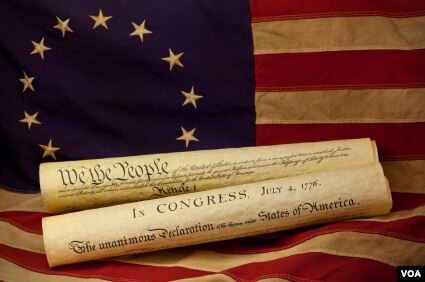
The Declaration of Independence - Program No. 12

October 10, 2013 21:05 UTC

Audio / The Making of a Nation

The Declaration of Independence - Program No. 12

An 18th century painting called "Congress Voting the  Declaration of Independence."
An 18th century painting called "Congress Voting the Declaration of Independence."

MULTIMEDIA

Play or download an MP3 of this story
  • American History: A Declaration Seeking Life, Liberty and the Pursuit of Happiness
TEXT SIZE 

From VOA Learning English, this is The Making of a Nation – American history in Special English. I'mSteve Ember.

This week in our series, we continue the story of the American Revolution.

The year was seventeen seventy-five. Colonists in Massachusetts had fought battles with British troops in the towns of Lexington and Concord. War had not been declared. But citizen soldiers in each of the thirteen American colonies were ready to fight.

Who was going to organize the colonists into an army?

This was the first question that faced the Second Continental Congress when delegates met in May in Philadelphia, Pennsylvania.

The delegates decided that the man for the job was George Washington. He had experience fighting in the French and Indian War. He seemed to know more than any other colonist about being a military commander.

The delegates elected him as commander-in-chief of the Continental Army. He accepted the position, but he said he would not take any money for leading the new army.

George Washington left Philadelphia for Massachusetts, where he took command on July third, seventeen seventy-five.  Jayne Gordon at the Massachusetts Historical Society says Washington looked very impressive.

"He was tall, he was very elegant, very well put together. It's very interesting because when he came to take command of the Continental Army, many of the New England soldiers were not quite sure what to make of this man who was, after all, from Virginia, not from New England. Washington won them over. His conduct, his grace, I think his discipline was extremely important."

Back in Philadelphia, the delegates to the Second Continental Congress made one more attempt to prevent war with Great Britain.  They sent another message to King George. They asked him to consider their problems and try to find a solution.

The king would not even read the message.

You might wonder: Why would the delegates try to prevent war if the people were ready to fight?

The answer is that most of the members of the Congress -- and most of the colonists -- were not yet ready to break away from England.  They continued to believe they could have greater self-government and still be part of the British Empire.

Jayne Gordon at the Massachusetts Historical Society says many colonists felt conflicted and confused about their identity.

"They're Englishmen, they're still Englishmen, but they're not Englishmen. All along what they've wanted is just to have the rights of Englishmen. And it doesn't seem to be possible under an old system."

A major battle took place in June of seventeen seventy-five, just two days after the delegates in Philadelphia chose George Washington as commander. It was the first major battle of the American Revolution. It was called the Battle of Bunker Hill, although it really involved two hills: Bunker and Breed's.  Both are just across the Charles River from the city of Boston.

Massachusetts soldiers dug positions on Breed's Hill. The British started to attack from across the river.  The Americans had very little gunpowder. They were forced to wait until the British had crossed the river and were almost on top of them before they fired their guns.  Their commander reportedly told them not to fire on the British until they saw the whites of their eyes.

The British climbed the hill. The Americans fired.  A second group of British soldiers climbed the hill. The Americans fired again. The third time, the British reached the top, but the Americans were gone. They had left because they had no more gunpowder.

Peter Drummey, a librarian at the Massachusetts Historical Society, reads part of a letter that a young soldier wrote to his mother.

"’I was in the fort when the enemy came in, jumped over the wall, and ran half a mile, where balls’ — that is, musket balls — ‘flew like hail stones, and cannon roared like thunder.’"

The British captured Breed's Hill. But Peter Drummey says the Americans still considered the battle a kind of victory.

"The paradox is, even though the American forces are defeated and forced off the hill, nevertheless the British casualties are so high it is at least a moral victory."

Even the young American soldier who fled the battle wrote to his mother that he would continue fighting for American independence.

"And in fact that's probably what the British learned from this battle. That they could capture this hill at great cost, but the New England countryside is full of hills and they couldn't capture them all back."

That battle also reduced whatever hope was left for a negotiated settlement. King George declared the colonies to be in open rebellion.

The American colonists fought several battles against British troops in seventeen seventy-five. Yet the colonies were still not ready to declare war. Then, the following year, the British decided to use Hessian soldiers to fight against the colonists. Hessians were mostly German mercenaries who fought for anyone who paid them. The colonists feared these soldiers and hated the British for using them.

In January of seventeen seventy-six, Thomas Paine published a document that strongly influenced the colonists. He named the pamphlet "Common Sense." It attacked King George, as well as the idea of a monarchy — a government led by a king or queen. The pamphlet called for independence.

About one hundred fifty thousand copies of "Common Sense" were sold in the colonies.  Everyone talked about it. As a result, the Second Continental Congress began to act. It opened American ports to foreign shipping. It urged colonists to establish state governments and to write constitutions.

On June seventh, seventeen seventy-six, Virginia delegate Richard Henry Lee proposed a resolution for independence.

The resolution was not approved immediately. Declaring independence was an extremely serious step. Signing such a document would make the delegates traitors to Britain. They would be killed if captured by the British.

The delegates wanted the world to understand what they were doing, and why. So they appointed a committee to write a document giving the reasons for their actions. 

One member of this committee was Thomas Jefferson of Virginia. He had already written a report criticizing the monarchy. So the other committee members asked him to write the new document. They said he was the best writer in the group.

They were right. Jefferson was thirty-three years old. It took him seventeen days to write the document. The Second Continental Congress approved it on July fourth, seventeen seventy-six.

It was America's Declaration of Independence.

Historian Gordon Wood at Brown University says the declaration sent a message to more than just the British.

"They're trying to, I think, to signal to the world, 'We are a new nation. We have broken away from this other nation. We're a separate nation and we want recognition of our independence.'"

The Declaration of Independence begins with these words:

When in the course of human events, it becomes necessary for one people to dissolve the political bands which have connected them with another, and to assume among the powers of the earth, the separate and equal station to which the laws of nature and of nature's god entitle them, a decent respect to the opinions of mankind requires that they should declare the causes which impel them to the separation.

The declaration goes on to say:

We hold these truths to be self-evident, that all men are created equal, that they are endowed by their creator with certain unalienable rights, that among these are life, liberty and the pursuit of happiness. That to secure these rights, governments are instituted among men, deriving their just powers from the consent of the governed. That whenever any form of government becomes destructive of these ends, it is the right of the people to alter or to abolish it, and to institute new government.

The British believed that the Americans were violating British law. Jefferson argued that the British treatment of the American colonies violated the natural laws of God.

This idea of natural law had been expressed by British and French philosophers more than one hundred years earlier. Jefferson had studied these philosophers in school. But in writing the Declaration of Independence, he said, the words came straight from his heart.

The declaration goes on to list twenty-seven complaints against the king. There are complaints against taxes without the consent of the colonists and against the presence of British troops in the colonies.

After the list, Jefferson went on to write this statement: 

That these united colonies are, and of right ought to be free and independent states; that they are absolved from all allegiance to the British crown and that all political connection between them and the state of Great Britain, is and ought to be totally dissolved; and that as free and independent states they have the full power to levy war, conduct peace, contract alliances, establish commerce, and do all other acts and things which independent states may of right do.

Jefferson concluded the declaration with a line that was meant to persuade the delegates to support the most serious step -- revolution.

And for the support of this declaration, with a firm reliance on the protection of divine providence we mutually pledge to each other our lives, our fortunes and our sacred honor.

Delegates to Continental Congress approved and signed the Declaration of Independence on July fourth, seventeen seventy-six.  The new country was called the United States of America, and it was at war with Britain. Yet, not everyone in the former colonies agreed with the decision. That will be our story next week.

You can find our series online with transcripts, MP3s, podcasts and pictures at voaspecialenglish.com. You can also follow us on Facebook and Twitter at VOA Learning English. Christopher Cruise read the words of Thomas Jefferson. I’m Steve Ember, inviting you to join us again next week for The Making of a Nation -- American history in VOA Special English.


martes, 10 de septiembre de 2013

                                 Ingles 
                  
food Libros   de  textos en  ingles 1-topnotch  2- Worldlink 0
Children clases 
http://www.sesamestreet.org/playlists#media/playlist_69


             Francés 

house                     Italiano            

mas  


 Otros  Idiomas
tips to have  a  better conversation 
http://learningenglish.voanews.com/section/engagement/4078.html

GOOGLE+ HANGOUT


Lincoln English School and Jhonant Services 
C/ Calle Sanchez No.103, Casi esq. Castillo. (809-816- 7217/809-725-0614
056-0064969-2
Centro operativo A-002 en el colegio Team Marin(809-244-1938)

Para aplicar para la beca completa pasar por el ministerio de juventud 


programa de capacitación y formación técnica en los diferentes cursos, Tales como:


-Inglés conversacional.
(Ingles básico I , Ingles básico II, ingles intermedio I, ingles intermedio II).


-Inglés avanzado.


(Conversación I, gramática y composición inglesa, fonética ingles y lectura comprensiva, conversación II y comprensión auditiva).


-Didáctica especial.

Aplicada a la enseñanza de inglés. (Pedagogía I y II).


-Guía turístico bilingüe.
(Introducción al turismo I y II, inglés intermedio I, Francés básico, geografía turística dominicana, inglés técnico para el turismo).

-Secretario ejecutivo bilingüe.
(Español 1 y Manejo de paquete de oficina (Word, Excel, PowerPoint, Access, etc.) Relaciones humana y técnica de secretaria ejecutiva Introducción al marketing y contabilidad básica

-Informática
(Windows XP, Windows 7, manejo de paquete de oficina, programación, creación de página web, redes e Internet como recurso educativo).

y  otros  cursos  ma

DURACIÓN 12 MESES Y ESTÁN DIVIDIDO POR NIVELES. 

REQUISITOS: 
-Carta personal de solicitud, dirigida al Ing. Jorge Minaya ministro de la juventud, explicando las razones por las cuales entiendes que debe ser beneficiado/a con una beca.


-Formulario de solicitud debidamente completado. 

-2 Fotos 2x2. 

-Copia de cédula. o  de  nacimiento o  pasaporte 

Edad 15 a 35 años.


Debe depositar estos documentos debidamente completados a la Dirección provincial Duarte del ministerio de la juventud, San Francisco de Macorís.


Para más información contactar Sandy Pérez, encargado de Programas de becas. 809-982-0832 / Sandy.p62@gmail.com
O pasar personal por la casa de la juventud
C/José Reyes #35, casi esq. Frank Grullón. S. f.m

las  personas  que  aplique  para  la  beca  y  son  seleccionados  por  las  personas  encargadas  de  la  becas  tomaran  los  cursos  ante  mencionados  totalmente  gratis
incluyendo  material  de  apoyo    

los  niños de  6  a 14 años resinaran un  50% de  descuento  ya   que  no aplican  para  la  beca  completa 

Audio / The Making of a Nation

Andrew Jackson vs. The Bank of the United States - The Making of a Nation No.46

Making of a Nation
Making of a Nation

MULTIMEDIA

Play or download an MP3 of this story
  • Andrew Jackson Part Two - The Making of a Nation No.46
TEXT SIZE 

From VOA Learning Englishwelcome to The Making of a Nationour weekly program of Americanhistory for people learning English. I’m Steve Ember.
This week we continue the story of the presidency of Andrew Jackson.

President Andrew JacksonPresident Andrew Jackson
Jackson took office in 1829. He was popular with many votersThey saw him as the symbol of thecommon man. But Jackson’s first term seemed to be mostly a political battle with his vice president,John C. Calhoun.

As his presidency went on, another struggle began. This time, it was Jackson against the Bank of theUnited States.

The First Bank of the United States had closed in 1811. But without a central bank, the country’sfinances had suffered during the War of 1812.

So in 1816, Congress provided money to establish the Second Bank of the United States. The bankcould provide loanspay billscollect taxes and move money around the country.

Congress gave the bank a charter to do business for 20 years. The government owned one-fifth of thebank. A small group of private citizens owned the restLawmakers gave the bank enormous power

The Bank of the United States had $35 million in capitalSome of that money came from thegovernmentMost came from investors.

Historian Bray Hammond notes that at the time, the Bank of the United States was the richestcorporation in the world.

The Bank of the United States also printed the country’s paper money. And it was the only bankpermitted to have offices across the nation.

By making it easy or difficult for businesses to borrow money, the bank’s owners could control theeconomy in almost any part of the United States.

What this means is that you are granting -- and Congress did grant -- exclusive privileges to the Bank of the United Stateswhich meant exclusive money-making opportunities to its stockholders.”

Historian Daniel Feller explains that the Bank of the United States helped the government to do itsbusiness effectively and efficiently. But it also helped the people who owned stock in the bank

Nicholas BiddleNicholas Biddle
During Jackson's presidency, a man named Nicholas Biddle led the Bank of the United StatesBiddlewas an extremely intelligent man. He had completed his studies at the University of Pennsylvania whenhe was only 13 years oldWhen he was 18, he was sent to Paris as secretary to the American minister.

During America's war with Britain in 1812, Biddle helped establish the Bank of the United States. Hebecame its president when he was only 37 years old.

Biddle clearly understood his power as president of the Bank of the United States. In his mind, thegovernment had no right to interfere in any way with the bank's business.

President Jackson did not agreeNor was he very friendly toward the bank. Not many people fromwestern states wereThey did not trust the bank's paper moneyThey wanted to deal in gold and silver.

Jackson criticized the bank in each of his yearly messages to Congress. He said the Bank of the UnitedStates was dangerous to the liberty of the people. He said the bank could build up or pull down politicalparties through loans to politicians.

Jackson opposed giving the bank a new charter. He proposed that a new bank be formed as part of theTreasury Department.

The president urged Congress to consider the future of the bank long before the bank's charter was to end in 1836. Thenif thecharter was rejected, the bank could close its business slowly over several yearsChanging the banking system slowly,Jackson saidwould prevent serious economic problems for the country.

But the bank’s president wanted to renew the charter early. He made the request in January 1832 — nine months before thenext presidential election

Jackson’s opponentSenator Henry Clay of Kentucky, was sure that the issue of the bank could win him some votesClayargued his case on the floor of the Senate for three days. He strongly urged the Senate to renew the bank's charter. He saidthe country was in the middle of a revolution, not yet a bloody revolution. But things were happening that pointed to a totalchange of the pure republican character of the governmentPower was being centered in the hands of one man, he said. Hemeant President Jackson.

Clay added that if Congress did not act, the government would failClay then asked the Senate to condemn Jacksonsaying heviolated the Constitution and the nation's laws. The Senate approved the resolution.

The chief opponent to the bank was Senator Thomas Hart Benton of Missouri. He objected to the renewal of the charter, he toldthe Senatebecause the bank was too great and powerful and made the rich richer and the poor poorer.

The Senate finally voted on the bank's new charter. The vote was 28 for renewal and 20 against. The House voted three weekslater. It also approved the charter, 107 to 85.

The lawmakers sent the bill to the White HousePresident Jackson debated it with members of his cabinetSome wanted tonegotiate a compromise. But Jackson decided to veto the bill in the strongest possible language.

On July 10, 1832, Jackson sent a message to Congress explaining his reasoningJackson said he did not believe the bank'scharter was constitutional.

Jackson also spoke of the way the bank moved money from West to East. He said the bank was owned by a small group ofrich menmostly in the EastSome of the owners, he saidwere foreignersMuch of the bank's business was done in theWest. The money paid by westerners for loans went into the pockets of the eastern bankersJackson said this was wrong.Then the president spoke of his firm belief in the rights of the common man.

"It is to be regretted," he said, "that the rich and powerful bend the acts of the government to their own purposes."

Jackson said that instead, the government should shower its favors — as heaven does its rain — on the high and low alike, on the rich and the poor equally.

Jackson’s veto of the bank bill may have cost him votes among the wealthy, but it earned him votes among the commonpeoplelike farmers and laborers. He easily won re-election in November of 1832. Martin Van Buren became his vice president.

Historian Daniel Feller says Jackson believed his victory meant that Americans supported his policiesincluding the bank veto.

“He had a very popular personal image. It’s possible he would’ve been re-elected by the same margin or larger anyway. Theone thing we can say looking forward is that whenlater on, you had somebody carrying on Jackson’s policies absolutelyfaithfullywithout Jackson’s personal charisma, he proved to be not nearly so popular.”

In his second termJackson stopped putting federal money into the Bank of the United StatesInstead, he put the money intostate banks.

The bank presidentNicholas Biddlefought with all his power to keep the bank open. He demanded that borrowersimmediately repay their loansBusinesses struggled without the bank's assistanceWorkers lost their jobs.

Biddle blamed President Jackson for the financial panic. And critics of Jackson’s bank policy called him “King Andrew theFirst.” But as time passedbusiness people began to see that the Bank of the United States was being much tighter in itsmoney policy than was necessaryThey began to feel that it was the bank’s president — not Jackson — who was responsiblefor the serious economic situation in the country.

Biddle took no responsibility for the financial crisis.

He then made a very bad decisionBiddle asked the governor of Pennsylvania to make a speech supporting the bank. At thesame timeBiddle refused to lend the state of Pennsylvania $300,000.

The governor was furiousInstead of making a speech supporting the bank, he made one that sharply criticized it.

Two days later, the governor of New York proposed that the state sell $4 or $5 million of stock for loans to help state banks. The New York legislature approved selling even more.

Strengthening state banks helped break the power of the Bank of the United StatesNicholas Biddle began to see that the battlewas lost. He started making more loans to businesses. The economic panic slowly ended.

Jackson's victory over the Bank of the United States was clearBiddle started to lose the support of many members ofCongress. In the House of RepresentativesJames Polk proposed four resolutions about the bankOne said the bank shouldnot get a new charter in 1836.

The second resolution said government money should not be deposited in the bank.The third said the government shouldcontinue to put its money in state banks. And the fourth proposed an investigation of the bank and the reasons for theeconomic panic in the countryAll four of these anti-bank resolutions were approved.

One of Biddle's aides described the feelings of bank officials. This day, he saidshould be ripped from the history of therepublic. He said the president of the United States had seized the public treasury and the representatives of the people hadapproved it.

Jackson won what he himself considered a glorious triumph.

Another major event in Jackson’s second term was the situation in Texas. The struggle over Texas and the Battle of the Alamowill be our story next week.

I’m Steve Emberinviting you to join us next time for The Making of a Nation — American history from VOA Learning English.


Para mas   inf 809-816-7217 Juan  Antonio Rodríguez
Licoln English school

otros desean  aprender
y tu puedes ser  parte del cambio  de vida de  otro
que  Dios te  la  inteligencia para  que  puede  entender
Dios nos  ha  dado todos , espesemos  a  compartir   

Mi lista de blogs

Mi lista de blogs

Powered By Blogger

Search

Copyright Text

Que tan importante es jhonant services